Tuesday, 13 October 2009

Like the Clouds, Like the Wind: Film Review

Title: Like the Clouds, Like the Wind (Kumo no you ni, Kaze no you ni)
Director: Hisayuki Toriumi
Writer: Kenichi Sakemi (Novella) Akira Miyazaki (Screenplay)
Year: 1990


It is claimed that people often mistakenly believe Like the Clouds, Like the Wind to be a Ghibli offering, since its character design was undertaken by Katsuya Kondo, who worked on Kiki’s Delivery Service and Ocean Waves (although more excitingly for me personally, he worked on the criminally underrated PS1 game Jade Cocoon), and the feel of the film, if not the story, seems to be cut from the Ghibli cloth.

The story is based in ancient China, though my knowledge of ancient Chinese history is sparse so I cannot comment whether the premise has any historical accuracy or whether it is entirely fantastical. The tale opens with the death of the current Emperor, and the subsequent crowning/throning of a new Emperor hails an Empire-wide search for concubines suitable to become the new Empress. The search throws up Ginga, a country girl who is inappropriately uncultured in the ways of the aristocracy. She is energetic, brash and comparatively boorish when seen alongside the contained and stringent respect-based understated dignity of the aristocracy. From the outset she is set up as the most unlikely person in the world to be become the new Empress, though I would argue it is purposefully clear from the outset that she is so wrong, she is right.

Ginga decides to put herself forward as a candidate after being told that the Emperor’s wife would enjoy the luxurious lifestyle of “three meals a day and time to nap”. Sometimes I shudder at the things I take for granted, when in ancient, possibly fantastical, times, people would have to marry an Emperor in order to enjoy the lifestyle I enjoy.

As the story unfolds, it veers back and forth from being an adventure story, to being a tale of romance, eventually incorporating a plot where a wholesale rebellion erupts. Rather than offering the story depth and nuance, I feel this eclectic approach makes the piece slightly too busy, where characters are introduced without enough time to explore them or even to allow them any real actions, making them feel like cameos, which I presume only has much impact for people who are familiar with the novella that the film is based upon. For instance, Ginga, upon reaching the Inner Palace, is made to share a room with 3 other potential-Empresses, and after a scene where we are introduced, including names and backgrounds, two of the characters have very little bearing on the actual story.

Though the animation draws comparison to, it doesn’t quite have the glistening style of a Studio Ghibli production, which isn’t to damn the film as Ghibli’s offerings are sensational.

I was slightly unsure whilst watching the film what sort of audience it was originally aimed at, for the background music; chirpy upbeat woodwind for the most part, and various characters’ reaction to punchlines; falling over and yelling, seemed to suggest that this was a kids film. However, there are some examples of explicitly vicious violence hidden in there, such as when the main character bricks an assassin in the face, or when a horse rider takes an arrow to the throat, or when a main character is impaled by spears. Multiple spears. Impaled. Violence in offerings meant for the Japanese kiddie market is hardly surprising, as they, the Japanese filmmakers, seem to take a far more laissez faire attitude, where there are moments of genuine hair-raising violence in, to return to previous comparisons, the works of Ghibli. It seems that while Western kids' films will allow some ‘mild peril’, the Japanese are happy enough to include ‘explicit impaling’. Not that I was overly bothered by this, just a bit shocked, as the film flits back and forth between overt violence and cartoony invincibility, where soldiers survive and stumble around covered in soot after a huge cannon is fired directly into the tunnel where they are charging.

There is also a suicide in the film, which is perhaps due to suicide being treated far differently in the Far East, especially in a historical context. Despite not being able to make up its mind between harsh violence and sweet silliness, the film does occasionally display a genuine deft suggestive touch, where adults will understand what is being hinted at, but, arguably, inappropriate topics will sail over the heads of children.

The film ends with an anticlimactic narrated outro, which is seemingly jammed in to make up for the lack of any genuine closure, and tries its hand at symbolism, where crows are nesting in the ruins of the citadel, and rearing their young, emphasising that new life can come from destruction. Aww, lovely.

All in all, the film won’t blow your mind, but it is quite nice. Damned by faint praise, sorry Kumo Kaze.

Wednesday, 7 October 2009

Mushishi: Film Review

Title: Mushishi
Director: Katsuhiro Otomo
Author: Yuki Urushibara (comic) Sadayuki Murai (screenplay)
Year: 2006

There is a penchant in Japanese media (anime/manga/film particularly) to hang onto a successful story and milk it for absolutely every last drop of sustenance, and then continue sucking. A prime example of this would be the novel Battle Royale, which was then adapted for manga, then made into a film, which also spawned a sequel. The problem with this process is, often, aspects of the piece will go missing, stories will change and the artistic vision of the original piece will often be altered or watered down.

Mushishi began its life as a manga, which I have not read, but according to Wikipedia:

“The Mushishi manga won an Excellence Prize at the 2003 Japan Media Arts Festival and the 2006 Kodansha Manga Award.”

So its original incarnation won critical acclaim. I first encountered Mushishi in its anime form, and was blown away by its engrossing measured pace and, to my trusting young eyes at least, unique style. For reasons I cannot remember, I never got more than a few episodes into Mushishi, though its standout opening track (The Sore Feet Song – Ally Kerr) and unnerving brand of unusual visceral horror branded itself into my brain.

The series wasn’t linked, as far as I had seen, by any more than its main character, silver-haired Ginko, the titular mushishi (bug master), as he travelled around ancient Japan curing those suffering from mushi-related plague like a ancient-Japanese silver-haired Jesus. Each episode followed a standalone plot, and I was interested to discover how these unlinked tales would be strung together over the length of an entire film.

Answer: they aren’t. Apart from one introductory tale, which I recognised from what little I’d viewed from the series beforehand, which is used to contextualise and introduce the role of the mushishi to the audience, the mini-stories are dropped, focusing more on the past of Ginko, following that ark as it comes full circle to the story’s present time. The lack of the unattached stories in the film is dramatically a good thing, as the plot would likely seem fractured and stuttered without the presence of the narrative ark. Having the past of Ginko explored also enables the audience to care more about the character, where if Ginko was merely a device in order to explore a number of mini-stories, he would seem hollow and 2D. The downside of not being able to include many of the side-plots is that people who are already fans of Mushishi will inevitably pine the lack of their personal favourite tale. This was certainly the case with me, despite having seen few episodes. The defining moment of my relationship with Mushishi in its anime incarnation was a scene where a character blinded by mushi that live in eyes, stood in complete darkness with a river of undulating silver unguent gushing skyward from his/her eyeballs. Moments such as that are few and far between, said the silly young man, wiping a tear from his eye.

Having spent an unjustifiably long time pontificating on what is not in the film, its probably time to tell you what is, for there is plenty there to be pleased with.

The film opens with slow, atmospheric shots of foggy mountainous woodland, distant prolonged shots where the ominous and mysterious nature of a non-industrialised natural world is fully accentuated. The subtitles appear to inform us this is turn of the century Japan, although which century is either not made clear, or I was too engrossed in the misty forestscape to notice. Suffice to say, this is the pseudo-surreal landscape of the none-too-recent past, with characters clad in tabi and sandals, conical straw hats etc. I found the style utterly true to the anime adaptation, which is a fantastically good thing indeed, the world created by Mushishi is utterly engrossing despite the fantastical nature of the tales. It is certainly the style that is most notable of the series, with the eeriness of the landscapes together with the aged, graininess of the footage and the deliberate slow pace of the storytelling transporting you into the story with ease.

The fantastical nature of the stories, centring as they do around ephemeral magic bugs (mushi), means that at times the story may be difficult to follow, especially since there is no time in the film for the sort of explicit explanations that occur in the series, but I would argue that this is a good thing, as the mystery of not knowing the exact nature of the creature adds to the overall ambience of the piece, as it thrives on oddness.

Despite omitting many mini-stories, the film still goes on for a fair old length, which may seem a hollow gripe, but since it is my only real complaint, I will have to follow through with it. Now I am a fan of lengthy works, although sometimes an abundance of material is simply evidence that the writers were utilising a ‘throwing-shit-against-the-wall’ technique, and this certainly isn’t the case with Mushishi, the problem is simply that there is too much good material to comfortably fit in. On the other hand had I known it was going to be something of a monolith before I’d pressed play, I might not have become shifty and agitated in the middle, wondering whether it would come to an end soon.

Sitting there actively wanting a film to end is never a good thing, but it is certainly the length of it, rather than a discrepancy in quality of content that places the ants in my pants on this occasion.

The film is also guilty of being accidentally funny, though again I can’t be sure whether this is simply my highly tuned comedy eye or my rampant de-sensitivity when it comes to the odd, but there were a few incredibly strange scenes that were perhaps meant to be taken seriously, where I couldn’t help but laugh.

Mushishi is a good example of strange and slow creepy horror, the sort which makes you twitch and clench your jaw rather than make you jump, the storyline has been honed to a fine art over its several incarnations, meaning that the film is a fantastic rendition of the story, rather than a heavily watered down version. If you are planning on watching it, however, bed down comfortably, get your snacks and your drinks in at the start, and attach the catheter, it’s gonna be a long one.

Sunday, 4 October 2009

Rosario + Vampire: Manga Review

Title: Rosario + Vampire
Author: Ikeda Akihisa
Genre: Supernatural, Action, Romance, Harem
Released: Season 1 - 2004-2007, Season 2 - 2007-Ongoing
Volumes: Season 1 - 10, Season 2 – 4


Aono Tsukune is one of those useless main characters who doesn't really seem to be able to do anything. The Manga starts off with him finding out that he hasn't gotten into a single High School and despairing about said lack of High School.
His parents turn around and tell him he'll be going to Youkai High School, a place they found out about from a pamphlet dropped by a totally not suspicious *cough cough* guy wandering around. With this being the only school to turn to, Tsukune decides to enrol and after a long bus journey with a disturbing driver it's not long before Tsukune discovers the true purpose of the school, which just so happens to be teaching monsters (Ayashi) the traditions and ways of humans, in the hope that one day both worlds could co-exist peacefully.
It also just so happens that the first schoolmate he bumps into, Akashiya Moka, is a vampire who just loves (elongate 'o' for mediocre comedic value) the taste of his blood. Moka is apparently so super-de-duperly powerful that she has to wear a rosary to seal her powers, and when it comes off it's like she's a completely different person.

Yet again we come across a series where regardless of how the author tries to convince you you will never for a second doubt the main character will get with one of the girls (in this case Moka). To be honest it's not like any effort is made to convince you otherwise, but that just makes the lewd passes (which happen annoyingly often) of the other girls unnecessary and waste valuable time that the main characters could spend fighting people. The past sentence isn't a symbol of my love of action, by the way, beating people up with the power of heart is the only thing these characters seem to do. Of course, the main character is a useless shit whose only purpose is to take off Moka's rosary. She then proceeds to pulverise the character while uttering the catchphrase “Know your place”. This wouldn't be anywhere near as annoying if she didn't use it every god damn time she beat someone.
One thing that seriously bugs me if I'm reading action is when the main character is dependent on someone else's power. This is a trait held by the Manga for so long that when he finally ended up less dependent on Moka's power (only less depended, by the way, not actually independent, that comes later -_-) it's like a ray of sunshine shining down the damp, dark well that Rosario+Vampire has shoved you into.
I would say that the Manga gets better as it progresses but to be honest that shouldn't really be regarded highly considering “better” is the only direction it's actually able to go.

Any characters other than the main ones (Moka and Tsukune) seem to be there purely to act as deus ex machina, or as filters so that the main characters don't have to spend a chapter wading through shitty weak enemies. Seriously, they have no place in the main other than as soldiers or informants, and taking away any of their little side-stories would probably increase my liking of the series tenfold.
The main characters themselves, however, I like. While Tsukune is similar to pretty much every action main character in existence, I've always liked the stubborn, hearty attitude that they get while fighting to protect his friends (which only really includes Moka, maybe the others are too busy sucking to be kidnapped or targeted) and his home.
Moka herself comes in two flavours, Strawberry and 99% Belgian Chocolate. Both of her personalities heavily contradict each other, although rather than separate personalities I can't help but view it as a switch to make the sweet Moka look cool and kick arse. The inner Moka (who just so happens to be the original one) isn't really explored that much, making her nothing more than another “Fight Mode” without a substantial face. She is also a huge cock-tease and more often than you would care to enjoy she leans in for what looks like a sweet kiss, only head straight for his neck and start sucking a different kind of juice to what Tsukune wants her to swallow.

The school itself seems to be there only to act as extra stuff to smash to itty bitty little pieces. You don't often see any studying going on and when it is nobody's paying attention. It also closes down for six month for repairs (the result of a fight between the main characters and various arseholes) and somehow all of the students still have the knowledge required to wander along into their next year.

The art is alright, not really making use of all the space it's given but too much can be a clutter and I'd rather space than clutter, to be honest.

The plot itself is as average as they come, with a nice little rival faction aiming to overthrow the human race, appointing Ayashi as the new rulers of the world. I have nothing against this considering it's a tried-and-tested plot that can easily be taken new places (not that the author tries). However it is full of holes, especially regarding Tsukune's fighting power. What you read in the latter part of what's been released for the second season should really be inserted in between the third and fourth quarters of the first one, and the first half of what's been released for the second season should be burned alive and buried underneath a mountain of shit.

If you can get through the curiosity of finding out what this series is really like, save yourself from the noose and run to the hills, because this series isn't really worth the effort.

Saturday, 3 October 2009

Mahou Sensei Negima: Manga Review

Title: Mahou Sensei Negima
Author: Ken Akamatsu
Volumes: 27 Volumes
Released: February 26, 2003
Genre: Harem, Action, Comedy, Magical girl


The Plot

Magician in training Negi Springfield dreams of being a Magister Magi (Latin for 'Master Mage'), one of the highest classes of magicians who travel the globe helping normal people while keeping their magical ability a secret. Negi's main reason for wanting to be a Master Mage is so he can find his father, Nagi Springfield, a legendary magician known as the 'Thousand master' who has been missing since Negi was young and is believed to be dead.

At ten years old Negi Springfield has graduated from the Merdiana magic academy and as per tradition he is expected to take up a pre-assigned job and continue his training. He soon finds out that his duty is to become a teacher at Mahora academy, where he will be teaching a class of 31 middle school girls. Soon enough Negi is enveloped in his students' and school's chaotic lifestyle.


What's Good

Author Ken Akamatsu is famous for his harem Manga Love Hina and it's nice to see him try a new genre although the romantic style comedy elements are still present. Slowly (at first), as the series progresses, the shift to a more action oriented plot is soon established and it is amazing to see how well some of the fight scenes are pulled off. The ever present perverted moments played for laughs due to the main character's young age and a lot of alike moments are more like subversions of the original jokes. Although a few of the characters play up to the typical clichés such as the 'shy girl' Nodoka Miyazaki, the nervous bookworm with a crush on the main character, it doesn't mean that it's tiresome. Rather these walking archetypes are comfortable to see and as with any tried and tested archetype or model they can still surprise you every once in a while.

What's bad

A major problem I feel I must mention is the whole 'creepy' angle the series can give off, with a ten year old pre-pubescent boy running around giving 'proper' kisses to girls to make 'pactio cards' (magical cards that grant the magicians 'partner' special abilities). There is also a point where the main characters get a hold of candy that can give the illusion of the characters being older or younger when consumed, which while tame by itself it does get a bit weird when characters remain in 'loli' form far longer than they actually have to. In one case the girl has, for reasons known only to the author himself, taken the opportunity to dress in frankly downright revealing clothing while in 'loli' form. With all this paedo-bait it can be a bit uncomfortable for even the most desensitised reader. Frequent breaks from the main story to mess about with comedic elements means that the Manga can be slow moving sometimes, and the latest two arcs have been ticking along for such a long time now that it might be seen as annoying by some readers. A more personal gripe for me is the claim that Negi is Welsh; while I always enjoy seeing my country referenced in anything I do wonder if the author actually understands exactly how the whole England and Wales thing works, because at times it can seem like he knows precisely what he's talking about (especially when talking about magical myths and such) and at other times I truly wonder if he actually has a clue what he's talking about (Negi often refers to himself as an 'English gentleman', for example).

Conclusion

If you can get past the slightly creepy nature sometimes seen in some of the chapters then this series is about average. It is a refreshing change from other action Manga with its blend of fighting, more traditional slight romantic elements and comedy, but it's still very mediocre in some ways. Although I personally enjoy the story I wouldn't exactly call it amazing, and although they don't detract from the overall enjoyment of the series the typical archetypes spotted in some characters do nothing to actually add to the story. I would recommend this Manga only if you're in the mood for a blend of magic, fantasy and harem.

Wednesday, 30 September 2009

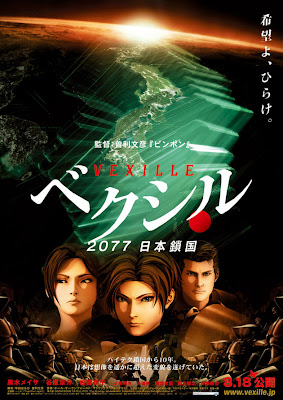
Vexille: Film Review

Title: Vexille (Bekushiru: 2077 Nihon Sakoku)
Director: Fumihiko Sori
Writer: Fumihiko Sori
Year: 2007


Being an ardent fan of tales where the future is portrayed as a nightmarish place, I was almost instantly enamoured of Vexille. By my reckoning, the more dystopian stories that exist, the less likely they are to come about. It is in times of hardship that incredibly cheerful productions are written and produced, as is shown by comedy being so successful in the recession. Already, I digress.

Vexille is set in the year 2077, in a world where robotics technology has began advancing at such a rate that the UN have banned further research on the subject, which in turn leads Japan to pursue a policy of complete isolation. This isolation includes the construction of an enormous series of signal towers around Japan, which release a scrambling signal and effectively remove Japan from sight. By 2077 Japan have been socially removed from world affairs for 10 years, and yet the Japanese Daiwa Corporation have absolute monopoly over the world’s robotics market, supplying the American technology police agency, SWORD, with all of their equipment. Suspicions about Japanese development of robotics, which, if it were taking place, would be in contravention of international law, are raised as SWORD are tipped off to a clandestine meeting between a number of politicians and a Daiwa representative.

Now, when it is discovered that the Japanese have indeed been developing new technology, the characters seem genuinely surprised, as though an entire country would have hidden itself away from the world in order to develop prettier flowers to give to orphans. Oh no, no, no, no.

The story follows the titular Vexille, a ludicrously buoyant-haired female member of SWORD, who is on a mission to infiltrate Japan in order to send out a scrambler signal to scramble the original scrambler signal so that the signal that scrambles satellites is then scrambled so that the previously scrambled satellites can see Japan clearly.

The film is a CG wonderpiece, that is occasionally effervescent in its glimmering shimmering hoo-hah, or at least it would be if it wasn’t set largely in a gritty hellscape populated by technologically-tortured refugees. What is particularly surprising about this situation is the flawless hair of every single character. I have trouble taming my mop on a good day, and yet it seems as though every Satoshi, Daisuke and Takashi are able to maintain their pristine visual kei headdresses even when eking out a living in an impoverished shanty town. It seems petty to niggle over unrealistically preened hairstyles when a far more significant suspension of disbelief is required to deal with the vast amount of koolwank that the action scenes are teeming with.

As I have just coined the term, I will attempt to define ‘koolwank’. This is where a scene included ludicrously superlative actions whose aim is to make the viewer go: “OMG kool!” and then have a wank. Examples of this from Vexille include a scene where the wing of a plane explodes through a wall of a mansion, forcing Vexille (clad in a futuristic battle-suit reminiscent of Master Chief) to dive to the floor in a blind panic, where a completely un-armoured Daiwa employee coolly ducks his head, reappears after the wing has passed, grabs hold of a handle on the wing as he does so and makes good his escape. Koolwank!

Despite all the koolwank, Vexille does occasionally fall back on the age-old Gundam technique of having skitterish robots that are far too prone to exploding after being grazed by a few bullets. Very unsatisfying.

As well as the pseudo-Master Chiefian suits, Vexille seems to have drawn heavily on other sci-fi sources for design inspiration. A number of unmanned robots roll around looking like the bastard son of Star Wars’ destroyer droids and the clean white turrets of Portal, the drop ships' mechanism is reminiscent of Starship Troopers, and archetypal sand buggy design leaves me unable to point out exactly what it is derivative of. Similarly, giant worm creatures, named Jags, as fresh and unique as they appeared to me, certainly seem to be a novel take on the sand worms of Dune fame rather than a completely original creation. Some sound-bytes feel as though they are cheeky nods to other sources, with one particular scene having a sound so similar to the ‘checkpoint cleared' ambient synth notification of the Gears of War franchise that it cannot possibly be coincidence. On occasion, these similarities make Vexille feel like a ‘Sci-Fi Greatest Hits’ medley, although I would argue that the film has just enough individuality to shine through on its own merits.

The setting and the premise of the film is admirably bleak and hopeless, but they strive all the way through to ruin this by offering hope, which is anathema to my misanthropic tastes. There is almost enough gruelling suffering throughout to satisfy my need for bleakness, but the powerfully corny addendum that closes the film leaves me with the taste of sick in my throat and the whiff of cheddar in my nostrils, but if survivors are what you like in a film then its likely you wont share my mild eye-rolling disgruntlement.

Despite all my sneering, my only real gripe with this film are the occasions where characters decide to mourn the suffering/loss of compatriots in the only way they know, which is to fall to their knees and scream the name of the suffering character-in-question and hold the scream out as long as they possibly can. Rather than the heart-rending tragedy this is meant to convey, instead it merely fills me with embarrassment for the actor stood in a studio repeatedly screaming. There are better ways to convey grief, i.e. quietly.

Apart from this aural terrorising, the acting and the ambient noise is solid, on top of which the soundtrack is utterly fantastic. The backing tracks are an eclectic mix of (according to Wikipedia) “electronic, techno, urumee melam and trance”, with featured artists including Asian Dub Foundation, Basement Jaxx, Boom Boom Satellites, Carl Craig, Dead Can Dance, DJ Shadow M.I.A, Mink and The Prodigy, with the music being ‘handled’ by Paul Oakenfold, whether that refers to editing, mixing or arranging it is uncertain. Though I am not a fan of these genres of music, the tracks are incredibly apt, and usually have a gritty or rocky backbone usually associated with more hardcore varieties of the genres.

All in all Vexille was an enjoyable piece, with certain characters being far more empathetic than is the norm for a feature length production, especially in an action-oriented film. Moreover it is a fascinating hypothetical thought-experiment in the tradition of the best of classic sci-fi works, although if that sounds too high brow or artsy then take solace in the fact that there are plenty of scenes where you will go “OMG kool!” And then you can go and have a wank.

Saturday, 26 September 2009

Bakemonogatari: Anime Review

Title: Bakemonogatari
Author: Nishio Ishin
Studio: Shaft
Released: July 3, 2009
Genre: Supernatural, Romance, Comedy


The Plot

Koyomi Araragi is a third year high school student who, after being made a vampire for a short time, is finally recovering. Unfortunately for him, he is soon thrust back into the unnatural when he catches fellow classmate and loner Hitage Senjogahara after she falls down the stairs and is amazed to find she weighs next to nothing...literally. After being threatened Araragi soon volunteers to take her to the same person who helped him overcome his vampirism, the homeless middle aged man Meme Oshino.

What's Good

The series' primary focus is on conversations between different characters. It is delightful to see some of these interplays and I find it enjoyable to see the different characters interact with Araragi and each other. The attitude of main character, Araragi, is also entertaining as he can go from calm and laid back to distressed and comically panicked in a split second. The series' new spin on the traditional supernatural monsters and main character saving the day formula is certainly interesting, especially since his first port of call after encountering people afflicted by the supernatural is to approach the expert, Meme.
The artwork is frankly gorgeous and I find the colouring of the art especially appealing, but that is an aspect you need to be shown rather than told.
The music for the opening and ending is also fantastic and are some of my favourites of this season.

What's bad

With the series focusing primarily on conversation, its habit of flashing up various words every now and again and the Author's well-known love for wordplay it is understandable that the inability to understand some parts of conversation and text can be frustrating, but this is a rather a gripe at my own inability to understand the language, although I do wonder how many Japanese people themselves are able to follow some of the wordplay. As well as being a conversation-heavy show the show can be rather slow-paced and this can become tiresome, especially if your interests are more action-oriented.

Conclusion

Bakemonogatari is a good series if you can look past the insanity of various flashing cards with words like 'red' and 'black' on them (a habit that Shaft is notorious for and it is certainly used just as often in their previous production “Zetsubou Sensei”) and losing out on some of the word play and satire. Even missing that the series is still fun to watch, though the slow pace can be off-putting and despite watching several episodes I'm still working my way slowly through the series.

Wednesday, 23 September 2009

Paprika: Film Review

Title: Paprika
Directed by: Satoshi Kon
Written by: Yasutaka Tsutsui
Year: 2006


It may be difficult for me to give an account of the work of Satoshi Kon without lapsing into hyperbole and hero-worship, but it will be good exercise for my objective muscles so lets have a go.

The basic outline of Paprika may seem deceptively simple; a medical institute have developed a machine, the DC mini, which allows dreams to be seen on a monitor and recorded, and also enables people to interface with the dream, literally placing themselves into the patient’s dreamscape. The inventor of the device, Kohsaku Tokita, imagines the wonders of being able to share in a friend’s dream, and also understands the medical and therapeutic breakthroughs the new technology could enable. Anyone familiar with Kon’s often dark plots will be able to pre-empt that all will not go as planned.

At the very beginning of the film several copies of the DC mini have gone missing, and very soon all psychedelia breaks loose. Madness is infecting the members of the institute where the DC mini was created, as the missing technology is being used to broadcast the dream of a mentally unstable patient into the minds of others, which is visualised using the, now iconic, parade; a noisy and frenetic convoy of insanity thinly disguised as jubilation.

The titular Paprika, then, is the dream-exploring alter ego of Atsuko Chiba, a psychologist working in the aforementioned institute, who attempts to provide therapy more effectively by experiencing the patient’s dreams alongside them. Needless to say, when the chaotic dream begins to leak out, it is Paprika who is best placed to combat the situation.

The film was marketed in the Western world with the tagline: “This is your brain on anime”, a parody of the 1987/88 anti-drugs campaign, likely due to the, for some, confusing nature of the film (I refrain from the phrase head-fuck), and the heavy use of frenetic psychedelic imagery. This is perhaps a strange choice, as the ‘drugs’ of the original campaign are depicted as damaging, thus you would expect the ‘anime’, placed in the same category, to also be damaging, although to be fair they were likely playing on the retro feel of the reference, hoping to gain publicity from that alone. This criticism of the tagline may seem slightly unnecessary, and of little consequence to the actual film, which is a fair point, however if I am to portray a positive and a negative side to the film, that is how far I have to grope for aspects I am dissatisfied with.

The film plays heavily on the line between dreams and the real world, for want of better terminology, constantly blurring the distinction between the two, and falling back on the old pull back and reveal technique. Overuse of the pull back and reveal would usually suggest a lack of innovation, and at times Paprika skates frighteningly close to being a parody of the “and then I woke up” story that you are forbidden to write as a child. However, Paprika manages to utilise this technique sparingly, and to great effect, perhaps aided by the slick visuals, with the change from dream to reality playing out in one scene as a layer of scenery is sucked into a vacuum, revealing the real world behind.

The film is wonderfully crafted with almost infinite examples of a deft artistic touch and, strangely for a writer and director that has such a long history of serious and dark subject matter, exquisite comedic timing. It is perhaps unsurprising that Paprika has some genuinely humorous moments, although actually laughing aloud may simply be evidence of my increasingly twisted humour, as a film which is so heavily invested in psychosis has its fair share of genuinely insane dialogue. In the examples where manic senseless dialogue occurs, the film wavers between the instant humour that can be derived from absolutely nonsense utterances, and the inevitable horror to follow, as these verbal explosions are precursors to complete mental breakdown. The example I have chosen to illustrate this is from the very first instance where it occurs, where a Doctor involved with the DC mini’s use exclaims:

“This whole festival was put together by thirty third-graders with lots of chutzpah and panda!”

before proceeding to jump of out of the nth floor window.

The characters are all fantastically designed, where the somewhat surprising difference of style between certain characters should jar, but in fact it stands up well, and effectively emphasizes the difference between them. It is likely that this occurs due to the film relying heavily on a suspension of disbelief, where if you are willing to accept that a dream can be entered and manipulated through the use of technology, accepting that a certain character is ludicrously overweight is less of an obstacle. But oh! How overweight. It wouldn’t be presumptuous to suggest that Mr Kon was really trying to make a point when designing Tokita, a man not only obscenely obese, but also strangely out of proportion with the rest of the characters, in the same way as toys often are (Spiderman and Mr Sinister were never meant to battle, and were a constant source of annoyance to me as a child).

The foul design of Tokita, whose bloated neck floats out further than his jaw, is counterbalanced by the slick power-dressing of Atsuko, and further by the casual indie-chic of Paprika. It is, however, in the backgrounds where the meticulous detail can be discovered. In particular, the parade scene is so detailed and busy that there a million and one pop culture references that may be being made, where brief bursts of recognition (there’s the Statue of Liberty!) are counterbalanced by the interminable frenzied march. There can be no doubt that these references are being made however, as Paprika briefly appears as Son Goku astride a cloud, from whichever incarnation of Journey to the West you would recognise that character from, and later appearing as Tinkerbell, although it is just as likely she is merely a archetypal fairy-character. More direct references to Kon’s other works are made, for the sort of fanboys who would enjoy that sort of thing (i.e. ME), where a cinema complex at the end features posters of Millenium Actress, Perfect Blue and Tokyo Godfathers. Similarly I had to wonder whether Paprika skipping ephemerally through the cityscape over the opening credits was an homage to the sort of skipping done in the climactic scenes of Perfect Blue, where if it isn’t it hints to a skipping-based obsession held by Satoshi Kon.

Alongside the psychedelic imagery that the film is most-likely known for, there are examples, with one butterfly scene in particular in mind, of deeply disturbing shudder-inducing visceral horror. The film really should feel busier than it does, as a piece including horror, psycho-thriller, psychedelia and occasional comedy shouldn’t be able to fuse comfortably, but Paprika seems to have achieved this fusion.

I was able to follow the story fairly comfortably on this viewing, though I have seen the film before. As this was a second (or perhaps third) viewing, I decided to view the film with the English dub, for as any pretentious anime purist/elitist knows, first viewings are in Japanese with subtitles if this option is available. Now I have no abiding memory of the Japanese voice acting, which would suggest that it was good, and by viewing the cast list, Hayashibara Megumi in the lead role, I can’t imagine that it was anything less than a stellar performance (this is criticism at its cutting edge). The English dub, however, is another matter completely.

It would seem unfair and reductive to criticise the voice acting by declaring that Paprika’s voice was annoying, but it was. Looking back on my notes I have actually written that her voice “makes me angry”. Apologies to Cindy Robinson, who will never work again now that she has suffered the death knoll of Animated Opinions' criticism. On the other hand, she also voiced Atsuko, and the voice she assumed for this role caused no irritation. It is simply possible that the ultra-cutesy style with which Paprika speaks works comfortably in Japanese, where there is a heavily trodden tradition of the cute, but English-language archetypal cutesy voiced characters merely cause irritation, and seem false and vacuous. On a, very tenuously, related note, one American-accented extra pronounces paella “pie-ay-ah”, which is a new one on me, and simply will not do. Unless of course my understood pronunciation of “pie-ell-ah” is incorrect, in which case: sorry America.

My final gripe, then, is the occasional example of blatantly expository dialogue. It would be interesting to see whether this is present in the original Japanese, but having too much information explicitly stated somewhat dulls the film, and patronises the audience, especially when the audience is as clever as I am. One example has Atsuko suggest that an elderly injured Doctor stay in hospital, as the meeting to cancel the project involving the DC mini needs to involve every member to be passed, with the Doctor himself then stating something along the lines of: “If I stay here, the meeting can’t go ahead!” which I greeted with a slow shake of my head and mild chagrin.

It is necessary to have it known that I have perhaps overcompensated with the negatives on this film, as I was afeard that I would drown the production under the flood of my enjoyment. The film is a thought-provoking, gripping and dark story, animated and depicted ingeniously, and backed with the experimental electronica of Hirasawa Susumu. Paprika is a continuation of the collaboration between Kon and Hirasawa that has been so successful in the past, and there are a number of standout tracks in the Paprika soundtrack, in particular ‘The Girl in Byakkoya’ and ‘Parade’, though to be fair the entire film is wonderfully scored.

Boiled down, what can be expected of Paprika is what can be expected from any other Satoshi Kon piece, enjoyment for your ears, popping of your eyes and an initial boggling of your mind, followed by its expansion.